
AI Readiness for Jamaican Workplaces What Comes Next

AI is already inside the workday. It helps screen applications, draft emails, summarize reports, answer customer questions, track performance, design training, and spot patterns in data. For Jamaican workplaces, the next question is not whether AI will arrive. It already has.
The real question is whether people will be prepared before processes change.

That preparation cannot sit only with IT. AI readiness is also an HR issue, a leadership issue, a training issue, and a trust issue. If employees hear about AI only when a new system appears, fear will fill the silence. If leaders start with clear purpose, skills, policies, and communication, AI can support better work without creating panic.
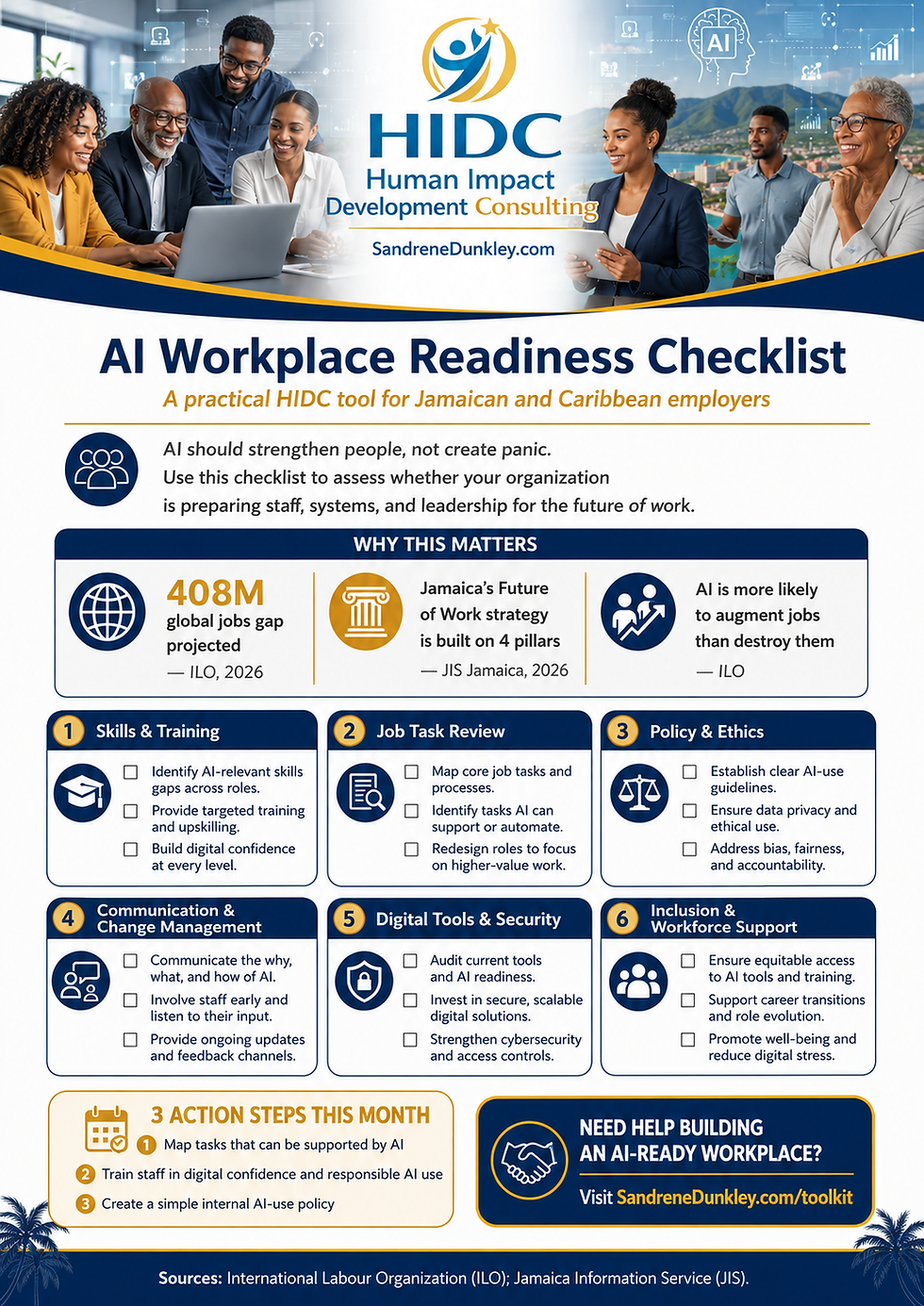
The International Labour Organization has reported that global labor markets remain stable, but that stability is fragile, with the global jobs gap projected at 408 million. The ILO has also stated that generative AI is more likely to augment jobs than destroy them, changing tasks rather than replacing entire roles. That distinction matters.
For Jamaica, where the Future of Work agenda points to AI-driven and technology-enabled industries, readiness must mean more than buying tools. It must mean preparing people.

AI readiness starts with HR
AI may run on software, but its impact shows up in human systems.
It changes how employees are trained. It affects job design. It raises questions about privacy, fairness, supervision, performance expectations, and accountability. Those are HR concerns.
When organizations treat AI as only a technical rollout, they often miss the people risks:
Employees may not understand what the tool does.
Managers may use AI outputs without checking them.
Job descriptions may become outdated.
Performance standards may shift without explanation.
Workers may fear they are being quietly replaced.
Sensitive employee or customer data may be entered into unsafe tools.
HR has to sit at the table early, before the software is purchased or introduced. This does not mean HR must become a team of programmers. It means HR must ask people-centered questions.
What tasks will change? Who will need training? What data will the tool touch? How will decisions be reviewed? What support will employees receive if parts of their role change?
AI Readiness for Jamaican Workplaces What Comes Next is not a technical checklist. It is a workplace change plan.
Look at tasks before job titles
One of the biggest mistakes leaders can make is asking, “Which jobs will AI replace?”
A better question is, “Which tasks can AI support, and which tasks still need human judgment?”
Most roles are made of many tasks. Some are repetitive and rules-based. Some require empathy, context, relationships, field knowledge, or ethical judgment. AI may help with parts of a job while leaving the core responsibility with the human worker.
For example, AI may support:
Work area | Tasks AI may support | Human responsibility that remains |
Recruitment | Drafting interview questions, summarizing resumes, scheduling communication | Fair selection, bias checks, final hiring decisions |
Customer service | Suggesting responses, sorting common questions, summarizing complaints | Empathy, escalation, judgment, service recovery |
Training | Creating draft learning materials, quizzes, and summaries | Local context, coaching, learner support |
HR administration | Drafting policies, updating templates, organizing records | Compliance, privacy, employee relations |
Operations | Identifying patterns in reports, flagging delays, summarizing updates | Decision-making, accountability, team coordination |
This task-based view lowers anxiety because it is more honest. It also helps leaders decide where AI can add value without making wild promises.
A Jamaican hotel, for example, may use AI to draft guest response templates, but frontline staff still need cultural awareness, tone, judgment, and service skills. A manufacturing firm may use AI to review maintenance logs, but experienced technicians still understand the equipment, safety risks, and site conditions. A public-facing organization may use chat tools for common questions, but complex cases still require trained staff.
The goal is not to pretend nothing will change. The goal is to name what will change clearly.

Train employees before technology arrives
Training should not be an afterthought. It should come before rollout.
Many employees are not afraid of AI itself. They are afraid of being expected to use it without guidance, being judged by tools they do not understand, or losing value in the workplace. Training helps reduce that fear because it gives people language, practice, and confidence.
Good AI training for the workplace should be practical. It should not drown employees in theory. It should answer real questions:
What is AI and what is generative AI?
What can these tools do well?
What do they often get wrong?
What company information must never be entered into public tools?
How should employees check AI-generated content?
When must a human make the final decision?
Who should employees ask when they are unsure?
Training should also be role-specific. Senior leaders need to understand risk, governance, and change planning. Managers need to know how to guide teams and review AI-supported work. Employees need hands-on practice with safe, approved use cases.
A one-hour awareness session may be a good start, but it is not enough for full readiness. Organizations need learning paths that match the level of exposure employees will have.
A simple starting point could look like this:
Awareness for all employees Basic AI concepts, workplace expectations, privacy rules, and safe use.
Manager training How to introduce AI without fear, review outputs, prevent unfair use, and support employees through change.
Role-based practice Examples tied to real work, such as drafting, reporting, customer response, scheduling, analysis, or training support.
Policy briefing Clear rules on approved tools, data protection, decision-making, and reporting concerns.
Refreshers and coaching Short follow-up sessions as tools and procedures change.
Training before rollout sends a clear message. The organization is not asking people to catch up alone.
AI policy protects more than the organization
A workplace AI policy should not be a long document that no one reads. It should be clear enough for a supervisor, HR officer, line worker, customer service representative, or department head to understand and use.
The policy should protect privacy, fairness, and accountability.
Privacy matters because employees and customers may share sensitive information. Staff need to know what data can be entered into AI tools and what data must stay out. This includes personal information, payroll records, medical details, disciplinary records, trade secrets, customer files, and confidential contracts.
Fairness matters because AI systems can reflect bias from the data used to train them or from the way people use them. In recruitment, promotion, scheduling, performance review, or disciplinary decisions, AI should not become a hidden authority. Human review must remain part of any decision that affects someone’s livelihood.
Accountability matters because someone must be responsible for checking AI-supported work. If an AI tool produces a wrong report, a biased shortlist, or an inaccurate customer response, the organization cannot blame the software and move on.
A useful AI-use policy should cover:
Approved tools and prohibited tools
Data that must not be entered into AI systems
Rules for checking AI-generated content
Limits on using AI in hiring, discipline, evaluation, and termination
Requirements for human review
Employee disclosure when AI significantly supports work
Steps for reporting errors, bias, or misuse
Consequences for unsafe or unauthorized use
The policy should also connect to existing HR systems. AI use may affect job descriptions, performance standards, learning plans, disciplinary procedures, data protection practices, and employee handbooks. If those systems do not change, confusion will follow.

Communication reduces fear and builds trust
Silence creates stories. When employees do not hear a clear message about AI, they fill the gap with rumors.
They may assume jobs are at risk. They may believe management is watching them more closely. They may think younger or more technical staff will be favored. They may resist the tool before they understand it.
Leaders do not need to promise that every role will stay exactly the same. That would not be credible. They do need to communicate early, often, and honestly.
A good communication plan should explain:
Why the organization is exploring AI
Which areas will be reviewed first
What will not change without consultation
What training will be provided
How employee feedback will be collected
How privacy and fairness will be protected
Who is responsible for answering questions
Managers need support here. Many supervisors are expected to answer employee concerns before they have been briefed themselves. That is not fair to them or their teams.
Before employees hear about a new AI tool, managers should understand the purpose, limits, timeline, and talking points. They should also know what not to say. Overpromising is risky. So is minimizing concerns.
Trust grows when leaders admit what is known, what is still being assessed, and how employees will be involved.
Jamaican workplaces need a readiness plan, not a panic response
AI adoption will look different across sectors in Jamaica. A hotel, call center, school, logistics company, government agency, retail chain, nonprofit, and small professional service firm will not all need the same tools or the same timeline.
Still, the readiness questions are similar.
Does the organization understand where AI may affect tasks? Have employees been trained? Are managers prepared to lead the change? Is there a clear policy? Are HR documents current? Is someone responsible for reviewing risks? Are workers able to ask questions without fear?
These questions help leaders move from reaction to structure.
A practical AI readiness plan may include five steps.
Assess the current state
Start by understanding what is already happening. Employees may already be using AI tools informally for writing, research, planning, translation, summaries, or customer communication.
The assessment should look at current tool use, skills, risks, policies, and employee concerns. This gives leaders a realistic starting point.
Map work by task
Review departments and roles at the task level. Identify tasks that are repetitive, time-consuming, data-heavy, or documentation-heavy. Then identify tasks that require judgment, care, legal review, trust, or human interaction.
This prevents rushed decisions based on assumptions.
Train people in stages
Begin with broad awareness, then move into role-based training. Give employees guided practice using realistic workplace examples. Include managers early because they will shape how teams experience the change.
Update HR systems
Review job descriptions, onboarding, training plans, performance measures, employee handbooks, data protection practices, and disciplinary rules. If AI changes how work gets done, HR documents should reflect that change.
Review and adjust
AI readiness is not a one-time project. Tools change. Risks change. Employee questions change. Organizations should review use cases, policy compliance, training needs, and feedback on a regular schedule.

How HIDC can help employers prepare
HIDC supports organizations that want to prepare for AI without creating panic or confusion. The work begins with people, systems, and readiness, not with pressure to adopt every new tool.
A practical readiness process can help organizations:
Assess current AI exposure and workplace risk
Identify tasks where AI may support productivity
Train employees and managers before rollout
Create or update AI-use policies
Align HR systems with technology-enabled work
Build communication plans that reduce fear
Prepare teams for change in a structured way
This is especially useful for Jamaican employers that need to balance productivity, compliance, employee trust, and long-term competitiveness.
AI readiness is not about rushing. It is about preparing workers, protecting the organization, and making better decisions before change accelerates.
Explore HIDC’s AI Workplace Readiness tools at SandreneDunkley.com/toolkit.
The workplaces that handle AI best will not be the ones that introduce tools the fastest. They will be the ones that prepare their people first, set clear rules, and communicate with respect.
What is your team’s biggest AI concern right now, training, trust, job security, or policy clarity?

Comments